
 Written by
 Emergency safety showers installed outdoors need to remain ready for use throughout the year. In locations where temperatures can fall below freezing, this means protecting the water supply and shower equipment from freezing while ensuring the system can still provide the required flow of water in an emergency.
There is no single solution for every cold-weather installation. The right type of safety shower will depend on the minimum ambient temperature, availability and reliability of the water supply, site conditions and whether the equipment is installed in a hazardous or non-hazardous area.
Why do safety showers need frost protection?
A standard outdoor safety shower can be vulnerable when temperatures fall below freezing. Water remaining within exposed pipework can freeze, potentially restricting or completely preventing the flow of water when the shower is activated.
Freezing can also damage pipework, valves and other components.
For sites exposed to low temperatures, emergency shower equipment should therefore be specified for the environmental conditions in which it will operate.
Frost-protected mains-fed safety showers
Where a suitable mains water supply is available, a frost-protected shower can provide a relatively straightforward solution.
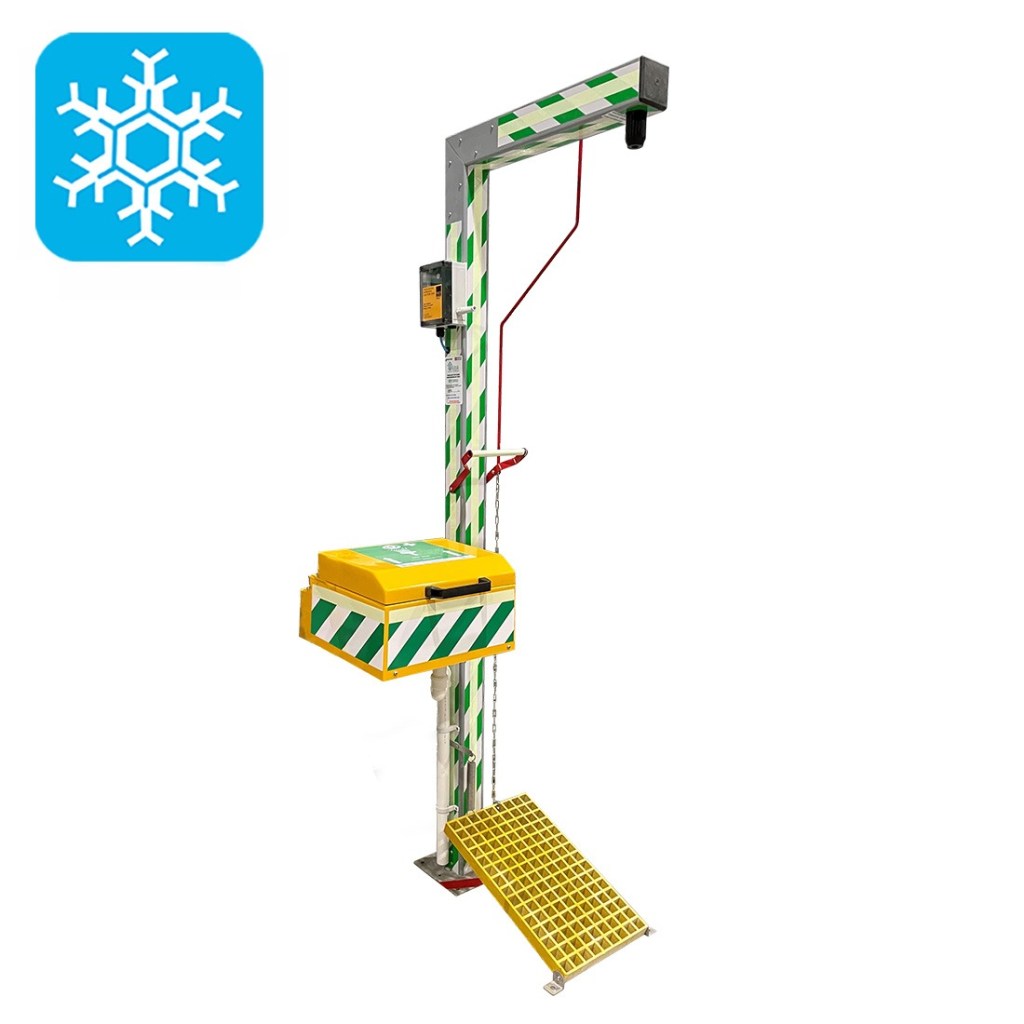
Aqua’s FS1H Frost Protected Safety Shower is designed for indoor or outdoor locations exposed to temperatures as low as -30°C.
Internal pipework is protected by trace heating cable to prevent freezing, while a corrosion-resistant GRP outer jacket provides additional protection from the environment and physical damage. An air thermostat controls the trace heating system, helping to reduce unnecessary energy consumption.
The FS1H delivers a shower flow rate of 76 litres per minute and can also be supplied with an optional eyewash providing 23 litres per minute.
It is suitable for non-hazardous areas as standard, with a hazardous-area version available.
FS1H at a glance
- Mains-fed
- Suitable for temperatures down to -30°C
- Trace-heated internal pipework
- Protective GRP outer jacket
- 76 litres per minute shower flow
- Optional eyewash
- Hazardous-area option available
- ANSI Z358.1 and EN 15154 compliant
For many industrial sites with a reliable water supply, a frost-protected mains-fed shower will therefore be the appropriate starting point.
What about extreme cold or sites without a reliable water supply?
Some installations require a different approach.
Remote sites may not have access to a suitable mains water supply, while extremely cold environments can require substantially greater protection for both the user and the water itself.
A self-contained heated safety shower can provide an alternative.
Aqua’s TS1500A Arctic Tank Shower has been specifically designed for extreme cold environments and can operate in ambient temperatures as low as -55°C.

The unit incorporates an insulated 1,500-litre GRP water tank and delivers a 76 litre-per-minute shower flow, providing more than 15 minutes of tepid water without relying on a mains water supply during operation.
An immersion heater protects the stored water, while the enclosed shower area incorporates an air heater and thermostat. The unit also includes internal lighting, a water level indicator, water temperature display and testing lever as standard.
Optional equipment includes an eyewash, changing room, alarms and additional lighting.
TS1500A Arctic Tank Shower at a glance
- Self-contained 1,500-litre tank
- Designed for temperatures as low as -55°C
- More than 15 minutes of tepid water
- 76 litres per minute shower flow
- Insulated GRP tank and enclosure
- Immersion heater
- Internal air heater and thermostat
- Water level and temperature monitoring
- Optional eyewash
- Suitable for hazardous and non-hazardous areas
- ANSI Z358.1 and EN 15154 compliant
Frost-protected or Arctic tank shower?
The main distinction is the environment and available water supply.
A frost-protected mains-fed shower such as the FS1H is designed for locations where a reliable water supply is available but the shower and its pipework need protection against freezing.
A self-contained Arctic shower such as the TS1500A is designed for more extreme environments and provides its own stored supply of heated water, allowing it to deliver emergency shower water without depending on the mains supply during use.
Minimum ambient temperature is important, but it shouldn’t be the only consideration.
What should you consider when specifying a safety shower for a cold climate?
Before selecting equipment, consider:
- The lowest expected ambient temperature
- Availability and reliability of the water supply
- Available water pressure and flow rate
- Whether tepid water needs to be provided or maintained
- Required duration of operation
- Whether an eyewash is also required
- Hazardous-area classification
- Available electrical supply
- Exposure to wind, snow and other environmental conditions
- Accessibility and location of the shower
- Testing and maintenance requirements
Assessing these factors at the specification stage helps ensure the selected emergency shower remains usable in the conditions it is actually likely to encounter.
Need help specifying a cold-weather safety shower?
Aqua Safety Showers manufactures emergency safety shower and eyewash equipment for a wide range of industrial environments, including locations exposed to freezing and extreme cold.
From frost-protected mains-fed showers to fully enclosed, self-contained Arctic units, our team can help assess your site conditions, water supply and operating requirements and specify a suitable solution.
Contact Aqua Safety Showers to discuss your cold-climate safety shower requirements.